Research is an interesting phenomenon in human evolution. I
am not separating biological evolution from cultural evolution here, because it
is essentially impossible to segregate the two. But there are multiple reasons
to believe that research evolved with us. It is there in human nature right
from our hunter gatherer life. Today, mainstream research is bound by a fairly
rigid structure for hosting, funding and publishing research. This has no doubt
boosted research output. But do we “understand” research? I have serious
doubts.
Successful researchers do not necessarily “understand”
research. Just as an experienced cricketer can take a fine catch with amazing
skills, but he need not understand which rules of physics govern the trajectory
of the ball and which motor neurons he needs to activate to instruct the right
muscles to enable the dive and catch. Physics knows the forces acting on the
ball fairly well, but our understanding of nerve muscle coordination is still
quite primitive, and limping to progressing.
The analogy is quite good for research. We often develop a fair amount of
understanding of the subject of investigation like the physics of the forces
acting on the ball, but have little understanding of the how the mind of an
individual researcher works and how the community of researchers interact. Not
knowing something is fair. But that is not how things are. The community of
researchers pretends to be what it is not. Also the way science is published is
not the way it is actually done. In a research lab, more often than not, things
develop rather chaotically, new findings are often serendipitous, experimental
work does not always progress in a logical sequence. Often one gets an
interesting result first and then wonders how it came about. Still when a research
paper is written, it is written as if everything was logical and sequential. Not
only that, if a researcher does not pretend that everything was done in a logical
sequence, he/she is unable to publish it.
This pretence (if it is better to avoid using the word hypocrisy)
is so common that researchers themselves do not know at what stage they start
the self-deception game. They make themselves believe that they are logical.
But this is not how research actually progresses. Research progresses through
complex behavioural, psychological and social interactions that have been
little studied. Hardly any one seems to be interested in studying and
documenting them. It is ironic that researchers themselves are not interested
in research on research.
Formally there is a branch of science called meta-science or science of science. There is a Wikipedia page on Metascience and it cites some landmark papers in this area. There are a handful of good researchers in this field. Intermittently they have published good papers in journals like Nature – Science. Science organizations and leading journals have intermittently worried about how to improve doing science and publishing science. But reading through this literature my feel is that they are too superficial. They are not yet addressing the human behavioural principles that govern science. They haven’t yet asked how these principles evolved. They are still pretending to be very ‘logical’.
I was fortunate that I took a late and backdoor entry into
science. My science training began after having completed my degrees in
science. I had no aspirations of doing a PhD. I got into it only because I saw
an opportunity to stay in a wildlife rich forest for a few years, with stipend!
That was my motivation, not PhD. After PhD I did not do a post doc anytime. I liked
teaching and was also lucky to get a teacher’s job quite quickly. I realized in
my first few years of teaching that research was the best tool in science education
and undergraduates the best persons to do research. That was my back door entry
into the field of research. Not having followed the routine path of research
career, I always looked at the research field as an outside observer mainly
triggered by my own curiosity about how the field works, than by any aspiration
of making a bright and successful research career. I discovered eventually that
this field was a highly fascinating subject to study the principles of
behaviour. The researcher community was more fascinating to observe and
experiment on than the elephant social life, multispecies interactions or the social
insect colonies that I was fascinated by. So I have seen things that the most people
within the community haven’t.
Of late I have started writing about it. One paper was
published a couple of years ago and a second one I just communicated to a journals
and also posted on preprint. This work is very preliminary, but the whole field
itself is preliminary. I know that this manuscripts will face a very hard time
getting published for reasons I have spelt out in the manuscript itself. But
here is an interesting situation. If my manuscript gets rejected, it
strengthens the hypothesis states in the paper. If it is accepted, it means it
is agreeable. Does that make it right or wrong? You decide.
The link to the paper published in the Journal of genetics is Here, and the one to the latest manuscript on pre-print Here.
I have been a science teacher all my life and the day I left
IISER-Pune, my formal career as a science teacher came to an end. IISER was not
a good environment for a science teacher anyway, but that apart, I am surprised
that I am not missing my classrooms very much. Feeling good on the one hand
that I won’t have to correct papers anymore, which I never liked, I also won’t
be teaching in a classroom which I loved all my life. I still love that but it
is strange that I am not missing much when I no more do that!
Perhaps I know the reason. A number of things that I did as a teacher continue even today. One is the katta. Now there is a katta at home every Saturday night, post dinner (no…no…. we don’t serve dinner. You have to have your dinner and then come). Interestingly some of the very first generation katta members, who are now well settled in their profession, have joined once again. Very soon, I believe their next generation will join. We have a more varied group now ranging from 12th entrants to grandmas, academicians to businessmen, students and housewives. First year collegians and their parents become katta members together. So katta isn’t dead, it has expanded.
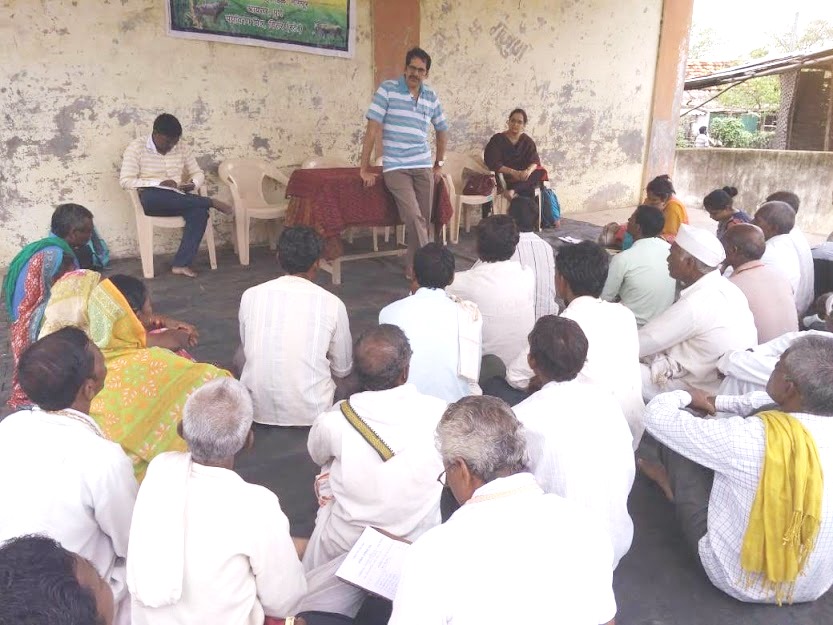
Farmers’ meeting at Wadala Tukum, 30th June 2019.
The classroom is also still there, though less frequent. Now
the class is attended by farmers, tribals and illiterates. Last week we had a
meeting with a group of farmers that I have been working with for the past many
years. Until the last meeting with them, I was a professor, with substantial
research funding. Unlike most social science or agriculture researchers, my
farmers are not my ‘subjects’ of research. They are my research partners,
colleagues and collaborators. Over the last few years an interesting chemistry
had been built between me representing a research institute, an active local
NGO called Paryavaran Mitra and its insightful social workers, Poorva Joshi of
Bioconcepts Pune and a group of over 70 farmers. Now only the research
institute has backed out. The rest of the group remains the same. A few years
ago we started with the spirit that let us study and understand our problems
ourselves and seek solutions.
Although the intention was to build a spirit of working
together, I always had some doubts in my mind. I belonged to an elite class of
scientists and professors in a prestigious institute, whether I liked it or not.
I brought funding for the research. In fact, because of the funding we could
organize lunch at the farmers’ meetings. Officially farmers were the ‘beneficiaries’
of the funded project (although I don’t like the word) and they were getting
the due benefits. I thought that majority of farmers might be coming because
they see those benefits. By our principles we, the researchers, are trying to
create a spirit of working together, facilitating collective intelligence,
community governance and so on. But that might just be our perception. Farmers
might simply be coming because they get free lunch, some money or other
benefits at the end.
When I resigned from IISER, the funding ended. IISER took a
very strange decision to continue utilizing my grants by appoint another
principal investigator on the project. This is not the norm in the field of
science. This was only a move to channelize money elsewhere. Research projects
are researcher centred, the institute only hosts them. The institute has no
rights to appoint a new investigator on an already running project, without
even asking the consent of the original investigator who wrote the project
proposal and mobilized the grants. But big people of science don’t need any
norms. Whatever they wish is the rule, whatever they do is the procedure. The
fact relevant here is only that now I was left with no funding.
Last week right at the beginning of the farmers’ meeting I
told everyone that I have no money in hand. Now I can’t give any ‘benefit’ to
anyone. Your work will not have any remuneration that we used to give from the
project funding. Now you have to make a decision. Do we continue the work
without any money or do we stop the project here? This was the acid test. My
doubts whether the farmers are participating out of a spirit of co-working or
they only come to get the ‘benefit’ would have been clear in no time.
And then came the biggest pleasant surprise. The moment I
explained that we have no more funding and asked them whether they wanted to
continue working, without a millisecond delay 80 hands were thrown in air in
unanimity to say, nothing will stop us. We will continue working together. What
I could read on those raised hands was, “We are not here because we get some
money. We are here because we discuss our problems here. Someone listens to us
and tries to understand us. He says let us all study the problems, try to
understand and seek solutions. He doesn’t pretend to be a messiah; doesn’t give
us any magic wand solutions, but only says let us work out our solutions
together. This is what we come here for. Not because we get some free lunch and
some money”.
I can see big parallels with my interaction with students
throughout my teaching career. I never promised them good grades and further admission
to best Institutes or good career opportunities. I interacted with students with
a promise of doing good science, opening up new questions and addressing them.
I never promised answers to their questions but said let us find ways to
address them. I am not here to answer your question. I am here to share your
questions and share the efforts to investigate and seek an answer. The
classroom and the farmers’ group are not different in any way.
The response that let us continue working together, we don’t care whether there is funding or not, is the best reward that a science teacher can ever get in life, the true Nobel for a scientist. And here lies the difference. I am tempted to compare the response of farmers to that of students when they learnt that I was leaving and that I won’t have funding anymore. They were more worried about their incomplete degree and their career than about the problems that we were investigating. I feel the illiterate farmers are better researchers than the top grade Masters and PhDs in science.
Farmers have given me another assurance. The science teacher in me hasn’t died and will not die.
Solutions to highly complex problems are
sometimes very simple and they come not from experts but from some insignificant
personalities. Very often they come from students and as a teacher I have
experiences this, multiple times. Here is an interesting example of a solution
that can potentially change entire India.
Caste system has existed in India for several
centuries and has shaped its social, political, economic, agricultural and environmental
history in a number of ways. As we take on the challenges of the modern world,
it is necessary to free the society of the woe of the caste divide. Although
some of the customs such as untouchability have been largely, if not
completely, eradicated, the caste system is far from being weakened. The concept of caste based reservation system
was introduced with an intention of the upliftment of the depressed class,
ultimately leading to an equitable society. But in democratic India, politicization
of caste based reservations appears to have strengthened the caste barriers
rather than dissolving them. Political parties seek vote banks in caste
appeasement and focus on luring and exploiting them rather than uplifting their
educational, livelihood and economic status. Any attempt even to review,
rethink or revise the reservation system is not beneficial for any political
party. Over the last decade we have seen increasing demand for reservation from
caste groups that were not classically considered as deprived. This has grown
into a vicious cycle and in the current political system there does not appear
to be a way leading to a homogenous, amalgamated society. Any appeal and steps
towards a casteless society are least likely to be politically supported and
viable. Therefore no political party could ever support, even utter such a
policy.
Given this political scenario, can we
even think of a casteless Indian society?
The answer is yes, a potential path to a casteless society emerged from a discussion with an undergraduate student at IISER-Pune. Swati Choudhary, was not a “brilliant” (by the conventional standards) student in my first year class. She had a tough life passing the first year but subsequently improved her academic grades.
But when I started the katta sessions, she opened up and started asking questions and her questions quite often were very original and out of the box. She raised the question of caste based reservations once and was quite upset about it. She herself was admitted to IISER through reservations but thought that there was something weird about the system and wondered where was taking us!! Over the next several weeks we thought and discussed the issue many a times. And one day a very practical solution emerged. Then we worked on it further for quite some time. Wrote a model and did numerical simulations on how it would work in the society.
Being in a research institute my first
instinct was “let us publish a research paper on this”. I realize now that it
was a bad thought and we wasted two years unnecessarily trying to publish the
idea in the form of a research paper. Now since I have come out of formal
science organizations, I realize that taking the idea directly to people is the
right way. By the way, we tried to publish this in social science journals and
the editorial correspondence and the names of the journals are available Here.
Whose idea was it? Swati thinks that it
was my idea and I think that it emerged through an interaction. I think on the
other hand, that there was no reason why I would have thought of this any time.
Swati raised a question and then we talked about a number of possibilities.
Ultimately I could articulate all the fragments together to build an executable
solution. So I can’t call it my idea. It emerged thorough our interaction. What
emerged is as follows.
The solution
consists of expanding rather than reducing caste based reservations in such a
way that caste based reservations would ultimately be ineffective without
having to remove them any time. The new policy being suggested would fulfill
the original objectives of caste based reservation and ultimately vanish on its
own after having served the purpose. No government would have to take the political
decision of removing caste based reservations, but the reservations will vanish
ultimately after having served their intended purpose.
The
new policy suggested here has three distinct goals (i) gender equality (ii)
towards a casteless society in education and jobs (iii) a true cultural
amalgamation. A true cultural amalgamation, the real long term goal is
extremely difficult to achieve since castes have divided the society for several
centuries. A change in the mindset of the society cannot be brought about by
any law. Nevertheless the first two goals can be addressed by law and they can
be important steps in achieving the ultimate goal.
The
proposed solution:
The
central idea of the proposed policy is that if a boy and girl belonging to two
different castes marry with each other, both of them as well as their children
should be identified in all official documents as belonging to both the castes.
If the two castes belong to two different reservation categories, they should
be allowed to avail reservation benefits of both the categories. This advantage
will be carried forward to their subsequent generations indefinitely. That is,
their entire lineage will be identified as belonging to two castes and if they
belong to different reservation categories they should be eligible for
seats/posts/scholarships and other benefits reserved for both the categories.
The caste based benefits are not restricted to reservations. There are several
other caste specific schemes for entrepreneurship development, community
development, welfare schemes, student scholarships, research grants and so on.
Families with multi-caste identities would be naturally eligible for dual
benefits but government can further plan to offer even greater benefits to such
multi-caste families which will ultimately pave the way to a casteless society.
Inter-caste
marriages do happen even now but generally the resultant family is said to
belong to the boy’s caste. Therefore today inter-caste marriages have little
impact on the caste system. There is no ethical reason why only the boy’s caste
should propagate. The well accepted idea of gender equality necessitates that
mother’s caste should be of equal importance. Therefore it is ethical that the
progeny can take the benefits, if any, of both the castes. The central idea of
the proposed scheme is not only to encourage inter-caste marriages, incentives
for which exist even today, but to give the resultant family a dual caste
identity.
Further
if a person with a dual caste identity marries with spouse belonging to a third
category, the couple and their entire lineage down the line should be entitled
for a three category benefit and so on. Ultimately there will be families that
are eligible for all categories and are thereby casteless and reservation less.
The proportion of such families in the society will go on ever increasing since
there is no way back. This policy along with other benefits and incentives for
inter-caste marriage will have a slow but far reaching and irreversible consequence
for the Indian society.
The
expected desirable effects and implications of the policy are as follows
Gender
equality:
With the new
proposed policy both the boy and the girl do not have to give up their caste
identity but at the same time they can avail reservation or any other benefits
of their spouse’s caste. This is a robust incentive for inter-caste marriages.
Here the girl coming from a different caste category brings in substantial
benefits to the family and this is duly recognized in her legal rights. In the
long run this will have at least a small contribution in uplifting the status
of the married woman.
Attractive
to the educated young generation:
The
best way to attract youth to inter-caste marriages is to offer them job
benefits immediately after marriage. It doesn’t make sense to offer any
educational reservations because we don’t want to encourage early marriages.
But after completing education, getting a job as a reward of inter-caste
marriage is guaranteed to be a big attractor for educated youth. In an orthodox
Indian society, the families and communities are unlikely to support
inter-caste marriages. But youth that are independent, educated and eligible
for jobs are expected to come forward and avail the offered benefits of
inter-caste marriage. Since the participation is entirely voluntary, the
classical reservation benefits of the extant castes will continue to exist for
the ones that remain away from the new trend.
Since
we expect inter-caste marriages to come from more educated youth, the relevance
of reservations will be lost only when the society as a whole is largely
educated and open minded. The benefits to the deprived classes will continue for
several decades to come which should be sufficient to improve their educational
and financial status. After that there is no need to remove reservations as a
political decision. They will slowly but definitely become irrelevant themselves.
A
culturally amalgamated society:
True
cultural amalgamation has to evolve within the society and cannot be enforced
by law, incentives or government policy. However, the above policy will support
and facilitate such a process and the effects will be apparent over a few
generations.
System
for implementation:
Successful
implementation of the policy will be data intensive. The traditional procedure
to certify the caste of a person was highly inefficient and subject to
manipulation. The new policy depends upon keeping accurate personal records over
several generations which are least prone to manipulation. This has been made
possible today by technology. The caste identity, inter-caste marriages and
dual or multiple category advantages can be linked to the Adhar database
and accurate multi-generational information would be available at the time of
marriage registration, school/university admission or job appointments. If
every marriage, divorce and birth is linked to the central database, it would
be next to impossible to manipulate the information.
Possible
frauds
We
should assume that in spite of all attempts to arrest manipulation, people are
likely to find some ways to make some jugad to take undue advantage of
the new policy. The common temptation would be to register fake marriage to get
a government job and then divorce. While divorce is a human right and it cannot
be prevented, some simple procedural specifications can prevent this
possibility. When a job is obtained through inter-caste marriage based reservation,
half the salary should go to the job holder and half to the spouse’s account
directly. This arrangement cannot be changed as long as the job is held
independent of staying or not staying together. This would be an effective
deterrent to exploit poor lower caste partners to get the benefits of
reservation and then divorce them. In any case, frauds of any kind will not defeat
the main purpose of the policy. So although there should be attempts to prevent
them, in reality, greater the fraud, faster would the rise in the proportion of
multiple caste identities and faster would be the progress towards a casteless
society.
How
long will it take?
We developed a
simple mathematical model that can predict the time course of the caste
dynamics under the suggested policy taking current population figures from Socioeconomic
and caste census, of Govt of India. The model shows that it would be invariably
a slow process in any case, but the change will be directional and
irreversible. The crucial determinant of the rate of change is the rate of
inter-caste marriages. If we go only be the current rate of inter-caste
marriages, it will be over 500 years just to get 5 % of the society in the
casteless category. But if there are attractive incentives for seeking inter-caste
partners, and the frequency of inter-caste marriages increases to twice what
can happen by chance alone, within 150 years, over 80% of the society will have
gone complete casteless. For the caste system that has been there for thousands
of years, 150 years is not a big time.
Possible
societal and political response:
As
people witness the multi-caste identity families getting greater benefits, they
are likely to increasingly support inter-caste marriages. The question is whether
any political party would be interested in any process whose results are so
much delayed. However, there is another potential political advantage. If a
ruling political party brings in this bill, how would other parties react? In
India it appears to be mandatory for the opposing parties to oppose any bill
proposed by the ruling party independent of any logic. However in order to
oppose, at least some logical and public appealing guise is certainly needed.
It is also important to avoid being politically incorrect by the current
standards. On these grounds it would be difficult to take an opposing stand.
Any political party has to support gender equality at least by lip service.
Since caste based reservations are never demolished, opposition cannot stand on
these grounds. Owing to the secular ideological correctness, mainstream media
are expected to uphold the bill making it further difficult for political
parties to oppose it. The party promoting the bill would be labeled by the
media as ‘progressive’, a label highly desired by all parties. Most important
feature of the bill would be that its effects on caste politics will appear
only over one or more generations. Vote banks will not be lost immediately, so
caste based politics need not be given up immediately which parties won’t like
to do. If a party can raise its progressive image without immediately losing
its caste support, it can see a tangible benefit in it. Therefore this policy
can be politically sound and viable from all angles.
I have no idea, whether anyone would read this, share and spread the word around. But social media have immense power, although they work somewhat stochastically. I would appeal all readers to spread the idea around. If it goes from readers to leaders, there would certainly be a political change and at least our future generations would be able to see a casteless India.
P. S. Within three weeks of my post, there is a court decision that mother’s caste matters in cases of intercaste marriage. See link,
I will try to explain why I think transparency in the review
process is a solution to most of the problems associated with scientific
publishing. But first of all why are peer-reviews necessary or are they; and if
they are, what purpose do they serve?
Personally I feel peer reviews are certainly desirable if
not “necessary” per se. Certainly, good science was being published prior to
1960s when only a few journals were practicing anonymous peer reviews. But the
community has changed substantially and publishing has changed even more.
Earlier, subscribers paid for a journal and authors did not pay for publishing.
Today the trend is that the authors pay and readers enjoy free access. This is
not only a technical change. It reflects the changing community, the changing
market forces in scientific publishing. So what worked in the early 20th
century may not work today. Analysing this change is worth a whole thesis, but
for the time being, I will only pen down my personal ‘belief’ that peer review
has become indispensable in the context of today’s scientific publishing.
What are peer reviews intended to do and what do they
actually do? I believe the original idea of peer review was to supplement the
thinking of one research group by others in the field, who may have a somewhat
different vision. It is possible and natural that researchers are often carried
away by their own hypothesis or that they might have adopted a narrow view.
This is likely to lead to partial blinding and inability to view the other side
of the problem, if any. Peers from the same field but with different points of
view can complement or at least point out other possibilities, any flaws or
paradoxes that might be arising along with the new finding being reported. Addressing the concerns of such peer
reviewers, the manuscript quality can improve substantially. Such a peer review
would be extremely helpful in any field of science.
However, this is hardly the purpose that today’s peer
reviews serve. They are mainly used to decide acceptance or rejection of
manuscripts. Often the accept/reject decision is taken first and then elaborate
justifications are sought for the decision. Often this is the main purpose and content
of the review report. This is partly because most journals are flooded with submissions
and are looking for convenient tools to get away from this overburden. So the original
purpose of peer review is completely lost.
This, in itself, is a substantial degradation of the peer
review tradition, but let us accept this as inevitable and see whether peer
reviews serve at least this function reasonably well. This is a valid question
and should potentially be testable. But it cannot be tested in the present
scenario because the data are not available for testing. So first of all,
simply in order to convince the scientific community that peer reviews really
serve the purpose, all peer review data should be made available, which means
the peer reviews should be transparent to everyone.
There are more reasons for insisting on transparency.
Although good journals can be assumed to choose reviewers carefully, there is
no guarantee that ultimately these individuals actually review the manuscript.
It is just too common all over the world that leading researchers find
themselves too busy to give time to a seemingly ‘unproductive’ work and they
ask their students, even undergraduates to do the reviews. This practice is common
throughout the world, but no data on it are available. If they have to do it
themselves, they can at the best devote limited time to it. This often results
into irresponsible reviews. Good researchers would not like to be called
irresponsible, but that is unlikely to ever happen because hardly anyone knows
who has written the review report. More responsible reviewers will not take a
review commitment unless they can devote sufficient time to it. Here lies the
major problem. The result of their responsible behaviour is that there are more
irresponsible reviewers in the field. If the reviewer remains anonymous, the
blame of irresponsible reviews goes on the editor. The editor presumably would
like the review process to be more responsible, but for an editor, finding a
reviewer is the foremost problem. Since most responsible researchers will not
commit unless they have sufficient time, which they never have, the editor has
hardly any choice. A transparent review will expose irresponsibility, if any,
and I think that may be sufficient to bring in more responsibility in the
review process.
Third is the problem of journal quality. The best way to
judge a journal’s quality is to look at the rigor and quality of reviews. But
since this information remains hidden, other indices such as impact factors get
an upper hand. There has been serious criticism of impact factors and other
numerical indices, but since the important remains hidden, we make the easily
visible important. If all peer reviews are made publicly available, the quality
of the editorial process will become transparent and grading of journals can be
based on what really matters in scientific publishing.
This will naturally drive away the menace of predatory
journals. The definition of a predatory journal is not that they extract money
from authors. Many good journals also do it. The definition depends upon
absence of or having a fake review system. If reviews are transparent, they
will be compelled to undertake serious reviews and if they do so they will no
more be “predatory”. So transparency of the review process is necessary and
sufficient to eliminate predatory journals.
Authors of rejected papers are often cribbing about unfair review. This might be often, if not always, true. There is a feel that manuscripts from authors from less known organizations or countries are more likely to be returned without review or face review by second grade reviewers. There is no way to test this since no data are available. Reviews can be unfair, biased or irresponsible. Even if a reviewer recommends rejection, the comments should be useful in improving the manuscript. My own impression based on the comments received on our manuscripts is that about 20 % of the comments are really useful in improving the quality of the manuscript, either for the same journal or for resubmission elsewhere; about 50 % are irrelevant to the central argument of the manuscript and attack some peripheral features of the manuscript or attack what has not been said in the manuscript; about 30% are factually wrong or unsupported. But my sample size is small, or my opinion might be biased. If the reviews are transparent, let readers decide whether reviews serve their main purpose or not, and for which journal the proportion of useful reviews is better.
But on top of all, I think science will benefit by studying the behaviour of different players in science and scientific publishing. Science is a human activity and all elements of human nature are very much there. Science does not progress by theorems, hypotheses and evidence alone. Certain components of the human mind and human social behaviour drive the progress of science. There are evolved psychological traits and diverse cultural traditions that decide how science progresses. What people in a field are ready to accept, what they reject and what they prefer to ignore are complex phenomena, not very clearly understood as of now. Studying these aspects of behaviour should have been an essential part of understanding science. However, the main source of data for such studies remains unavailable due to the unnecessary and religious confidentiality of the editorial process. It is utmost necessary to break this barrier.
What are the hurdles in bringing in transparency? One is the
power structure in the scientific community. Transparency challenges the power
of the powerful and we can expect extreme resistance to transparency from the
politically powerful lobby in science. For an open minded, well intended true
scientist, I am unable to imagine any reason not to support transparency of the
editorial process. Anonymity at the most, is understandable, and sufficient to
minimize personal conflicts potentially arising from review reports. But there
is absolutely no reason why the reports should not be made public. The other
hurdle would be from authors lacking confidence. If they feel their manuscript
has weaknesses which are exposed by the peer review, they could be reluctant to
publish them. But certainly any honest editor or reviewer, and any confident
but open minded author would certainly support transparent peer review systems.
How to publish peer reviews?
Scientific publishing has changed substantially by the
emerging pre-prints culture. Pre-print services also allow uploading revisions.
Now just one more step is to include the review reports and authors responses
along with the revisions independent of acceptance or rejection. My experience
with BioRxiv is that they objected to disclosing the journal name, but
published the comments and our responses that we uploaded. So a new path to publish
peer reviews is opened up, although with some constraints. If you have posted
your pre-print you can always post the review reports you receive. In case this
doesn’t work, authors can do so on their own blogs. This is what my attempt here
is. I have no idea at the moment whether and how it will click. What I mean by
‘click’ is a few more researchers feel like doing so. I presume authors
confident about the quality of their work would respond positively, others will
not. But in case the trend clicks, I have no doubt, it will revolutionize
scientific publishing.
Links for a few more reviews of our manuscripts here:
Inferring causality from
correlations: This is an age old problem with a lot of philosophical
discussions, but little usable sound methods helping actual causal inference.
We hit upon what we though was a possible major break-through. We had usable methods
to infer causality from correlations provided there were three or more
intercorrelated variables, not two. There was simple but sound mathematical
basis for all the methods. The only problem was that this was coming from a biology
lab, not a mathematical statisticians’ group. We got five rejections in a row
before publishing finally in PLOS ONE (https://journals.plos.org/plosone/article?id=10.1371/journal.pone.0204755).
All the editor’s responses and the original manuscripts communicated are available
Here.
Interestingly some found it too complex and some thought the mathematics was too
simple to publish. Nowhere, in the reasons for rejection, our central argument that
causality can be inferred from correlations using a set of methods was
challenged.
We had communicated an
article to Behaviour and Brain Science. It was rejected saying that we just
published another article in a similar field and we do not publish many
articles in the same field. Our article had no overlap with the central
argument of the earlier published article, just that it was in the same field. Incidentally
a few weeks later another article on the same subject was accepted, and that
came to me for comments. I pointed out that the reason that you gave for
rejecting our paper is not true since your journal does publish many articles
in the same field. So give some other, more logical excuse for rejecting our
manuscript!! This was followed by a series of emails in which a number of secrets
of the editorial process were revealed, but the editor raised strong objections
for making these emails public. So I am posting Here
only the rejection letter and my response to it.
Over a decade ago, I met a highly successful US based scientist of Indian origin. He routinely published, and publishes even now, dozens of papers in the most prestigious flagship journals. I have read much of his work with interest and have seen that he has consistently delivered excellent publications on the cutting edge of science. I asked him whether he thought he could do the same quality of research if he worked in India. Without having to think for a moment, he answered frankly, “At least in my field, I have no doubt, I can do the same quality work in India. What I am not so sure is that I would be able to publish it the same way!” He added further, “Publication is a mafia. If I am not in the circle, I won’t be able to publish. It is not enough to have good quality work, you need to have connections in the influential circles.”
Several years later I had a conversation with a celebrated
scientist, a Noble Laureate himself. We were together for three days and he
listened to my work and my ideas with interest. Then he said, “With a mind like
yours, I won’t be surprised if you publish in Nature, Science, Lancet, PNAS
quite frequently.” My spontaneous response was, “Try publishing from India and
you will know.” He did not blink, only nodded. He did not need more than a
moment to imagine and agree fully and instantaneously.
Everyone seems to know how the world of scientific
publishing works. I won’t use the word ‘mafia’ myself. It is better left to discussions
over coffee with successful elite scientists. But like every researcher I know
that scientific publishing is a field loaded with so many weird problems, only
a few of them surface once in a while and receive some attention, discussion
and debate. Being a student of behaviour, I see many fascinating behavioural phenomena
happening here, which make wonderful research problems. But the existing system
of scientific publication does not permit any research of this kind. This is
mainly due to the sacred confidentiality of the editorial process. The field of
meta-science or the science of science is an extremely weak, almost
non-existent effort. The handful of low ranking researchers in this field do
publish something realistic and insightful once in a while, but which largely
remains ignored by the scientific community and therefore has hardly made any
impact on main stream science so far. Although ultimately it aught to make an
impact, at present they are constrained by unavailability of data, which is
largely due to the unnecessary confidentiality of the editorial process.
Most working scientists are fully aware of the flaws in the
peer review system but they consider them ‘necessary evil’. Most seem to think
that there is no better alternative and therefore let the system be what it is.
But what if the evil is growing exponentially? Perhaps it is, and that is being
felt as well. One cannot show the trend using any data, because all data remain
hidden. There is nothing more ironic in the field of science. Entire science is
based on availability of data and the main pillars of science are interested in
hiding all data. Today science is moving rapidly towards a culture of open
access, open source; where most journals now insist that authors make their raw
data public in some form or the other. But the same journals are not ready to
make the review process transparent and accessible to the public.
What really goes on under the carpet of confidentiality is left to anybody’s imagination. We only
need to know that scientists are humans too and everything that goes on in the
human world, does happen in the world of science too. Just that it remains
hidden. Some journals now publish the reviewers’ comments along with the paper,
but this is limited to accepted papers alone. All rejection related
correspondence always remains hidden and there lies the real problem.
Interestingly, unlike the popular belief among students, a confidential review process is not a time tested tradition. It is fairly recent in the history of science. Out of the 300 papers published by Einstein, only one was subject to anonymous peer review and the comments were quite negative. Einstein himself made some nasty comments on it and withdrew his manuscript never to publish again in any journal with confidential peer review. Nature considered peer reviews as mandatory only by 1967 and Lancet by 1976. Mandatory peer review exists only for one or two generations of researchers. This is not long enough to say that it is a time tested system. The system has remained stable only because all possible ways of challenging it are blocked. Unless journals make the review data and particularly rejection data available to any meta-science researcher, the system cannot be claimed to be fair. Whenever, the peer review system has been tested, it is found to be highly flawed. There are only a handful of attempts to test it and they are published as well (for example see 1-6). So the most important activity in science, that of publishing stands on demonstrated unscientific principles.
The confidentiality of peer review has given rise to an entirely different problem, that of the so called “predatory journals”. Predatory journal is a big trap created by editorial confidentiality of the mainstream scientists. At present there are problems even in defining a predatory journal. There is no way to demonstrate that these journals publish without good quality peer reviews. They can always escape saying that we follow rigorous peer reviews but they are confidential so we cannot disclose. There is no use blaming such journals because this ghost is created by the mainstream journals themselves.
Can scientific publishing be made scientific? Can it be brought out from its religious fervour? We can certainly answer this positively and the way to do so is also very clear and simple. Bringing transparency in the editorial correspondence is the only and ”simple” way out. The reason I put the word simple within quotes is that it is conceptually simple, but not simple to execute because it will change the power structure in the field and so the currently powerful people will be reluctant to give up.
There is some justification for confidentiality and some of it’s reasons are genuine, but not intractable. The review process can be made public without affecting the anonymity of reviewers, or keeping anonymity optional for them. Many journals already have this option and this takes care of almost all potential problems arising out of transparency.
It’s not that things are not changing. Many journals are
exploring different options for peer review. Some tried double blind peer
review. What could be a sound looking idea, is actually not behaviourally
sound. If a reviewer receives a manuscript from unknown authors, by human
nature, the first reaction is to guess who could the authors be. The focus of
the reviewer then goes on picking up indirect cues by which the author identity
could be guessed. This guesswork does not help in eliminating biases, it might
make it even more weird. So double blinding cannot be said to be a successful
alternative. But there are more practical alternatives and there are attempts
to try them out.
Last month we had a pleasant surprise. On communicating a manuscript to PLOS Biology, we got a request from the editors for our consent for an open public appeal on BiorXivs and on twitter for comments on our manuscript. We gladly consented. There were hardly any comments in the public domain, apart from brief ones showing positive interest, but based on three comments confidentially received by the journal the editors rejected our MS. I wrote back saying in the spirit of open peer review that we have consented for, the comments and our responses to them should be posted along with the pre-print. After a series of emails, two of the three reviewers and the editors consented and we posted the comments and our responses on BiorXiv (see the comments section of https://www.biorxiv.org/content/10.1101/553016v1 ). I think making the peer review public is a significant historically important development. Now BiorXiv accepts posting reviewer comments and author responses for a rejected manuscript. They declined to disclose the name of the journal. But the journal itself had tweeted that they are reviewing our manuscript, therefore BiorXiv’s stand of not disclosing the journal name is meaningless anyway. I feel the rejection was a blessing in disguise and a first hand experience of this new tradition is a greater reward.
On this background, I have made one more decision. I will also make the comments received on my other manuscripts public on my own blog along with our responses to it whenever appropriate. I see no reason for not disclosing the journal or the editor’s name. Reviewers mostly remain anonymous anyway. This activity will be independent of acceptance or rejection. I will also write back to the editor asking them to inform the reviewers that we have published your comments, and our responses to it, if any, and you are welcome to react on it further. I am sure that although a small step, this will potentially be a turning point. If a number of authors start making the reviews public, the reviewers will have to be more responsible for the comments they write. This increased sense of responsibility, by itself can reduce the problem substantially.
Is it illegal to do so? I see no reason. On at least half a dozen times, after getting a rejection, I asked the editors would they mind if I make all the editorial correspondence public? On this I received an amazing diversity of responses, including sheer panic, desperate defence of editor’s rights to rejection (which I had not challenged in any case). I further asked many of them whether they would take a legal action if I make them public, and under which law? For this they did not know whether there was any legal protection to the confidentiality of the editorial process. But without worrying about legality, I have decided to do two things in this blog. One is that I will publish my analysis of optimization of behavioural strategies of the different players in the scientific publishing game in a series of articles. This is a fairly large volume of work that could potentially make a thesis. But I will restrict myself to a series of (non-peer-reviewed) articles. The other is that I will start publishing the comments that we received for manuscripts communicated from our lab, one by one on this blog. This will apply to previous years too. I will encourage other researchers, particularly from the younger generation to watch this and decide whether they too would like to make the reviews public. If a critical mass (which need not be too large) of researchers start doing so, at the best it will bring in a revolution in scientific publishing in no time. At the least, it would provide excellent research material for researchers in history and philosophy of science and meta-science.
See these links to the editorial correspondence and peer
reviews (along with follow up correspondence in some cases) of rejected
manuscripts from our lab during the last few years.
Rejection by Diabetes Care for our manuscript “How much variance in insulin resistance is explained by obesity?”. After receiving the rejection letter, I asked the editor, whether I can quote some comments from the rejection letter in any future article. I received a very long response. In this letter the editor actually agreed completely with our main argument. The long letter did not say anything about not allowing me to quote. So I am publishing the entire correspondence Here.
We wrote a response letter to an article published in the Lancet, which the editors declined to publish. Then we wrote to the authors directly that for us publishing was not important but we had raised a question and would like to know your response to the question, which may be in the form of a personal email to us. The authors did not respond to this.
A network model of type 2 diabetes, that had somewhat surprising and non-conformist outcomes, which was ultimately published by PLOS ONE, was rejected first by a number of leading journals. In none of the rejections, out central arguments were challenged. The reasons for rejection are very interesting and worth reading. Through subsequent submissions, the manuscript did improve a bit, but the comments received were hardly of any use towards improvement. You will find the editorial correspondence with Cell, Cell Metabolism, PLoS Biology, PLoS Computational Biology, Biology Direct and PLoS One here.
I will keep on publishing more editorial correspondence about rejections as well as acceptance one by one on this blog.
Phillips J. S. 2011 Expert bias in peer review. Curr. Med. Res. Opin. 27, 2229–2233.
Lee et al 2013 Bias in peer review. J. Am. Soc. Ino. Sci. Tech. 64, 2–17.
Haffar et al 2019 Peer review bias: a critical review. Myo Clinic Proc. 94, 670-676.
Tomkins et al 2017 Reviewer bias in single versus double blind peer review. Proc. Natl. Acad. Sci. USA. 114, 12708-12713.
Kuehn B. M. 2017 Peer review: rooting out bias. eLife 2017;6:e32014
Tancock C. 2018 When reviewing goes wrong. The ugly side of peer review. Elsevier Connect March 23, 2018.

 My science, My way